How to Choose Your First Credit Card in India
A five-step, jargon-free guide to picking your first credit card in India, eligibility, fees, choosing by spending pattern, and the mistakes to avoid.
Five steps to your first card
- 1
Check your eligibility honestly
Most starter cards expect a regular income of around ₹20,000-₹25,000 a month and a decent credit history. New to credit? Look at cards from your salary-account bank, which can see your income directly, or consider an FD-backed secured card that approves almost everyone.
- 2
Map your top three spending categories
Pull up three months of bank statements and find where your money actually goes, online shopping, food delivery, bills, groceries, fuel. Your first card should pay the most on your top two or three categories, not on categories a poster made sound exciting.
- 3
Compare real costs, not headline rates
Check the joining fee, the annual fee and, most importantly, the waiver bar. A ₹499 card waived at ₹1 lakh annual spend is effectively free for most users. Then read the reward caps and exclusions: a '10X' rate capped at a few hundred rupees a month is worth less than a flat 1.5%.
- 4
Apply for one card, not five
Every application triggers a hard credit enquiry, and several in quick succession make lenders nervous and dent your score. Shortlist properly, pick one card, and apply once. If you're rejected, wait a few months and fix the reason before trying again.
- 5
Set up autopay before your first purchase
Set up an automatic full-statement payment from day one. Paying the total due, never just the minimum, on time, every time, is what builds your credit score. Keep utilisation under about 30% of your limit and your first card will open doors to better ones within a year or two.
The mindset that makes this easy
A first credit card is not a status symbol or free money, it's a credit-history building tool that pays you a small rebate for spending you were doing anyway. Judged that way, the decision simplifies enormously: you want low (or zero) fees, decent rewards on your actual spending, and an issuer whose app makes bills easy to pay.
A few things beginners overestimate: lounge access (you'll rarely use it on a starter card), welcome bonuses (one-time sugar), and headline reward multipliers (read the caps). A few things beginners underestimate: the annual-fee waiver bar, the exclusion list, and the sheer long-term value of an unbroken on-time payment record.
If you can't get approved yet
No income proof or no credit history? Ask your bank about a secured credit card backed by a fixed deposit, approval is nearly automatic, the FD keeps earning interest, and the card reports to credit bureaus just like any other. Six to twelve months of clean usage is usually enough to qualify for the mainstream cards below.
One rule above all: never carry a balance. At around 3.5% interest per month, revolving credit wipes out years of rewards in a single quarter. Autopay the full amount, always.
Good starter cards
Low or zero fees, forgiving eligibility, and rewards on everyday spending.

Amazon Pay ICICI Bank Credit Card
ICICI Bank
- Joining fee
- Nil (lifetime free)
- Annual fee
- Nil (lifetime free)
- Genuinely lifetime free, with no joining fee, no annual fee and no spend condition to keep it active
- 5% back on Amazon.in for Prime members (3% for non-Prime), completely uncapped
- 2% back at 100+ Amazon Pay partner merchants and a flat 1% on all other spends
SBI SimplyCLICK Credit Card
SBI Card
- Joining fee
- ₹499 + GST
- Annual fee
- ₹499 + GST
- 10X reward points on popular online partners such as Apollo 24|7, BookMyShow, Cleartrip, EazyDiner and Netmeds
- 5X points on all other online spends keeps non-partner internet shopping rewarding
- Very low ₹499 + GST fee, waived on just ₹1 lakh of annual spend
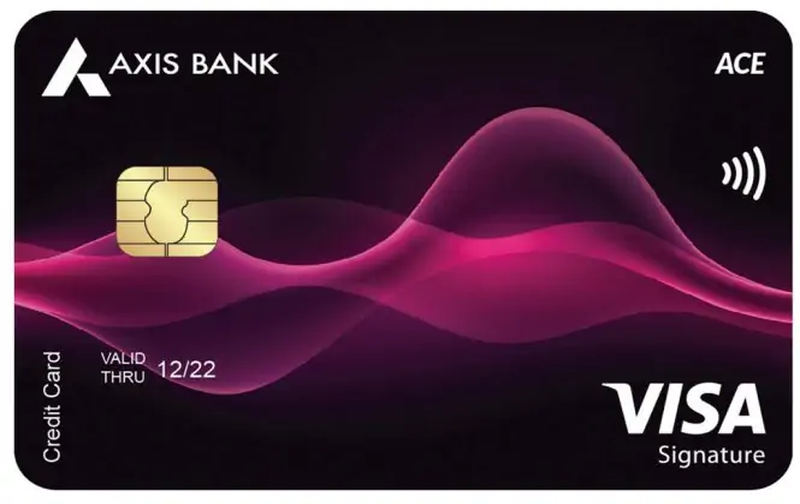
Axis Bank ACE Credit Card
Axis Bank
- Joining fee
- ₹499 + GST
- Annual fee
- ₹499 + GST
- 5% cashback on utility bills and mobile or DTH recharges paid through Google Pay
- 4% cashback on Swiggy, Zomato and Ola
- Flat 1.5% unlimited cashback on all other spends, with no cap
First-card FAQs
What is the minimum income for a credit card in India?
Entry-level cards typically expect around ₹20,000-₹25,000 of monthly income, though banks weigh your overall profile, salary account relationship, existing deposits and credit history all help. Premium cards expect substantially more. If you fall short, an FD-backed secured card has no meaningful income requirement.
Can I get a credit card with no credit history?
Yes. The two reliable routes are applying with the bank that holds your salary account, which can judge you on income it already sees, and taking a secured card against a fixed deposit. Both start reporting to credit bureaus immediately, and within about a year of on-time payments you'll qualify for mainstream unsecured cards.
What credit limit will I get on my first card?
Typically between ₹20,000 and ₹1 lakh depending on your income and profile; secured cards usually set the limit at 80-90% of the fixed deposit. Don't chase a high limit early, use the card normally, keep utilisation under about 30%, and banks will raise the limit on their own within a few review cycles.
What mistakes should I avoid with my first credit card?
The big four: paying only the minimum due (interest compounds brutally at around 3.5% a month), missing due dates (score damage plus late fees), maxing out the limit (high utilisation hurts your score even if you pay in full), and applying for several cards at once (multiple hard enquiries). Autopay the full statement and all four mostly solve themselves.
Ready to pick your first card?
Browse every card we cover, filter by lifetime-free, and compare your shortlist side by side.